James Tomkins's patients fill in his medical forms before he arrives. Sometimes at the clinic. Sometimes at their kitchen table. Sometimes at one of the four care homes he visits each Friday, before the home has even told him there's a new resident on his list.
Friday is care-home day. James Tomkins runs four care-home clinics across the Portsmouth area, treating residents on-site rather than asking them to travel. Many of those residents have dementia or limited capacity and can't reliably tell a podiatrist what medication they're on or what their medical history looks like.
Each care home has a persistent Finger-Ink link. They use it for every new resident.
“Often they will come back and I will see on Finger-Ink a new patient's name before they've told me there's a new patient at the care home,” James says. “They're just happy to click it. There you go, there's my referral in.”
That's a workflow Finger-Ink wasn't designed for. It's now part of how James practises.
James trained and worked as an NHS podiatrist before going private. His reason wasn't money. It was that the NHS was becoming more restricted in what it could treat, and he wanted to focus on prevention — keeping people out of the system in the first place.
“For me, I'm a preventer,” he says. “If I can prevent you coming into the NHS in the first place, let's go do that.”
He set up J E T Podiatry in May 2021. The clinic itself is one room inside a shared multidisciplinary practice in Southsea, alongside chiropractors and counsellors who have their own reception team. From there James also runs one day a week of home visits and one day a week across the four care homes. One business, three care settings, no front desk of his own.
Before Finger-Ink, every patient meant paper. James would run through medical questions on the go, sometimes putting people on the spot in a way he didn't like. He'd take the paper home, scan it in, upload it, store the original.
“It would take up easily a good 30% of my time with the patient behind the scenes,” he says. “And I found putting people on the spot sometimes wasn't always the best way to find out their medical stuff.”
That mattered clinically, not just operationally. James works with sharp blades. He performs nail surgery. He treats patients on blood thinners and patients with diabetes. Knowing what someone is on before he picks up a tool isn't a nice-to-have — it's a clinical safety requirement.
James didn't find Finger-Ink through the Cliniko integrations directory. He saw it in use at a colleague's clinic during a transitional period between leaving the NHS and starting his own practice. That clinic was using it for one thing: nail surgery consent forms.
“Oh, this looks really professional,” James remembers thinking. “This looks really quite nice.”
When he set up his own practice, he came back to Finger-Ink and discovered it could do far more than consent forms. Today he runs nine to ten different form types — medical history, procedure consents (verrucas, nail surgery, general intake), GDPR and data protection — all syncing to Cliniko.
“It's very pleasing to the eye, very soft and very delicate.”
- James Tomkins, Owner & Podiatrist, J E T Podiatry
James's practice doesn't have one waiting room. It has three care settings and a fourth (home visits) that changes every week. The form workflow has to travel with him.
In clinic, patients receive a Finger-Ink link in their booking confirmation email and complete the form at home before they arrive. For home visits, the same link goes out with the appointment confirmation. If a patient hasn't completed it by the time James gets there, he opens the form on his phone and fills it out with them in five minutes.
The care-home workflow is different again. James sends each care home a persistent link — one that doesn't expire. The nursing team uses the same link for every new resident. Where a patient has capacity, they complete the consent form themselves, often handed an iPad by a nurse. Where a patient can't, the nursing team completes the medical history on their behalf. Either way, the information is in Cliniko before James arrives.
“So I'm in the care homes every Friday,” he says. “The forms will come through, and I will then be advised that we've got a new patient in that care home, and will get asked — can you see them next time? — they have their forms done already.”
Today, James estimates that 19 out of 20 patients across all settings complete their forms before he sees them. The remaining one in twenty he handles on his phone, in person.
James's older patients are not the demographic most software companies optimise for. His clientele runs from ten years old to one hundred and five. Most of them have smartphones. Some are working with dementia. He needed forms that anyone in that range could complete without help — and crucially, without feeling like they'd been handed a piece of technology to wrestle with.
Finger-Ink's conditional logic is doing the heavy lifting. Patients see one question at a time. If they tick “no” to a medical condition, the follow-up questions for that condition simply don't appear. “They can answer 20 questions and not even realise it,” James says. “Because they can just zip through it.”
A form that prints to two or three pages on paper feels, on a phone, like a handful of taps.
“Even a 104-year-old managed to do it for me.”
- James Tomkins, Owner & Podiatrist, J E T Podiatry
There's another small detail James keeps coming back to. When a patient finishes a form, Finger-Ink shows them a personalised thank-you screen with their first name on it.
“It would say, like, thanks, Jack,” he says. “And it makes them feel special. They're like, I did that form, I got a little thumbs up and I've got my name on it.”
It's a fifteen-second moment at the end of a five-minute task. James notices it because his patients notice it.
Finger-Ink is built in New Zealand. Cliniko is Australian. James operates in Portsmouth. Geographic distance is a question UK prospects sometimes ask before they commit, so it's a question worth answering directly.
“Customer service and support wise is far better than the things I've seen this side,” James says. “You guys have just a fresher way of looking at things, whereas sadly, UK-wise, everything seems to be 2D, and it's very boring and very flat.”
On the practical question — does the product feel built for UK clinics? — his answer is a straightforward yes. Even though there are time-zone gaps, answers can arrive overnight or within the hour. But they arrive, with clear answers and guidance that always ensure your questions are covered. And nothing about the product feels built for clinical settings in a different market.
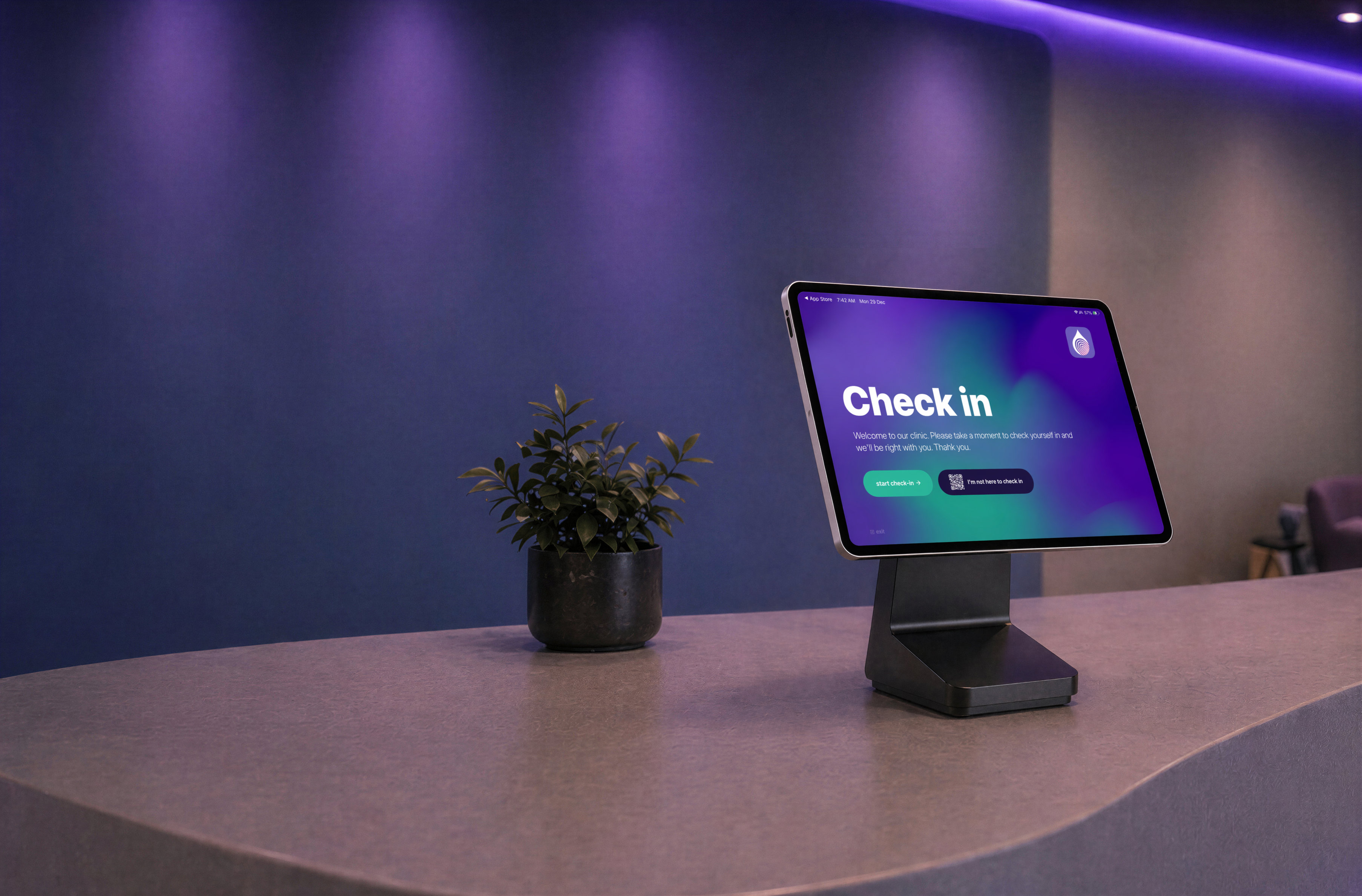
James's long-term plan is a standalone clinic of his own — somewhere with a waiting room, a front door, and the operational room to set up a kiosk for patients who haven't completed their forms before they arrive. For now, the shared-clinic environment doesn't have the space, and the building's reception team handles arrivals. Forms are doing the work that needs doing.
See if Finger-Ink can come with you. Start a free Finger-Ink trial. Syncs with Cliniko in under an hour. No credit card required

Patient check-in kiosk and intake forms for allied health clinics.