How Newcastle Aquatic Physiotherapy tamed its complexity with Finger-Ink, and turned an overwhelmed front desk into self-service check-in.
Newcastle Aquatic Physiotherapy is not a simple clinic. Nine practitioners. A pool that requires permanent supervision. Patients arriving through four distinct pathways, each with different forms, different referral requirements, and different booking rules. When Sarah Colston took over as owner, she needed a system that could handle the complexity. What she found was Finger-Ink.
Newcastle Aquatic Physiotherapy has been serving its community for almost twenty years. Originally based at a hospital, then moving to its current facility in Newcastle, New South Wales. The practice has a pool, a gym, and treatment rooms. It specialises in orthopaedic rehab, osteoarthritis, chronic pain, neuro and NDIS clients, and prevention classes in the water and on land. On any given day, four to six practitioners are seeing patients, classes are running, and independent pool users are moving through the facility.
Sarah Colston worked at the clinic for fourteen years before taking over as owner when the founding practitioner retired. She describes herself as “a very good physio” who is “learning how to do all business stuff.” The operational side of running a nine-practitioner clinic with a pool, multiple patient types, and a diverse patient population (including elderly, NDIS, workers’ compensation, and multicultural communities) was not something she had trained for.
What she inherited was a complex operation running on manual processes. Patient check-in happened at the front desk, which during peak hours between 9am and noon was regularly two or three patients deep. Forms were, in Sarah’s words, “very haphazard.” Some were paper-based. Others were Word documents emailed to patients, who would fill them in and email them back. The completed forms were then scanned, renamed, and manually uploaded into the patient management system.
Cliniko’s native forms had been tried briefly. Sarah’s assessment was blunt: “Not very pretty” and “not doing quite what we wanted.”
Online booking, something most clinics take for granted, didn’t exist. The clinic was too complex for unrestricted self-booking. Private patients, NDIS referrals, aged care patients, and workers’ compensation cases each had different requirements. Letting anyone book freely would have meant staff spending their time shifting appointments and chasing missing documentation. It would have created more work, not less.
Sarah’s coach at Clinic Mastery, a business coaching programme for clinic owners, suggested several tools to look at. A tech-savvy friend pushed her further, encouraging her to explore what Finger-Ink could do beyond basic forms.
The trigger wasn’t a single pain point. It was three converging at once: the front desk was overwhelmed during peak hours, the forms process was haphazard across multiple patient types, and Sarah was trying to enable online booking for the first time — something the clinic’s complexity had made impossible until now.
She approached Brendan, Finger-Ink founder, with a challenge. Could Finger-Ink build a conditional routing system for the clinic’s website: one that asked patients questions before they could book, and sent them down the right pathway depending on their answers?
“My mate is all about the techie stuff. He’s just like, you can do this stuff. He’s like, it’s worth asking. And Brendan was like, it’s a challenge. Let me take a look into it.”
— Sarah Colston, Owner & Physiotherapist, Newcastle Aquatic Physiotherapy
Brendan said yes. And that willingness to take on the challenge was what set the relationship in motion.
The custom website booking flow Brendan built for Newcastle Aquatic is the most advanced Finger-Ink implementation in the programme. It works like this: when a patient goes to book from the website, the system asks a series of questions. Depending on their answers, one of three things happens. Standard patients go straight through to book an appointment. NDIS patients are directed to fill out an NDIS referral form. Aged care and third-party patients are told what documentation they need to provide before they can proceed.
Sarah calls this the “clicking point”, the moment she realised Finger-Ink could solve her online booking problem, not just her forms problem.
“I think that was our clicking point - trying to work out how we could get some online stuff happening without just having people book in and then having to shift appointments and just making more work for ourselves.”
— Sarah Colston, Owner & Physiotherapist, Newcastle Aquatic Physiotherapy
Before this flow existed, online booking was off the table entirely. The clinic was too complex. Patients couldn’t be trusted to book the right thing without being triaged first. The website flow changed that. It sits upstream of the booking itself, routing patients through the right pathway before they ever see a calendar. It is not a form. It is not a kiosk. It is a patient routing engine, and it demonstrates that Finger-Ink can do things most people don’t expect from a forms-and-kiosk product.
The front desk at Newcastle Aquatic has to be permanently staffed. The pool requires someone with eyes on it at all times. But during peak hours of 9am to noon, when classes are running, practitioners are seeing patients, and independent pool users are coming through, the reception queue was regularly two or three patients deep.
“The kiosk was a big game changer. For us to be able to get people checked in without it having to be the person at the front desk who was often two or three people deep.”
— Sarah Colston, Owner & Physiotherapist, Newcastle Aquatic Physiotherapy
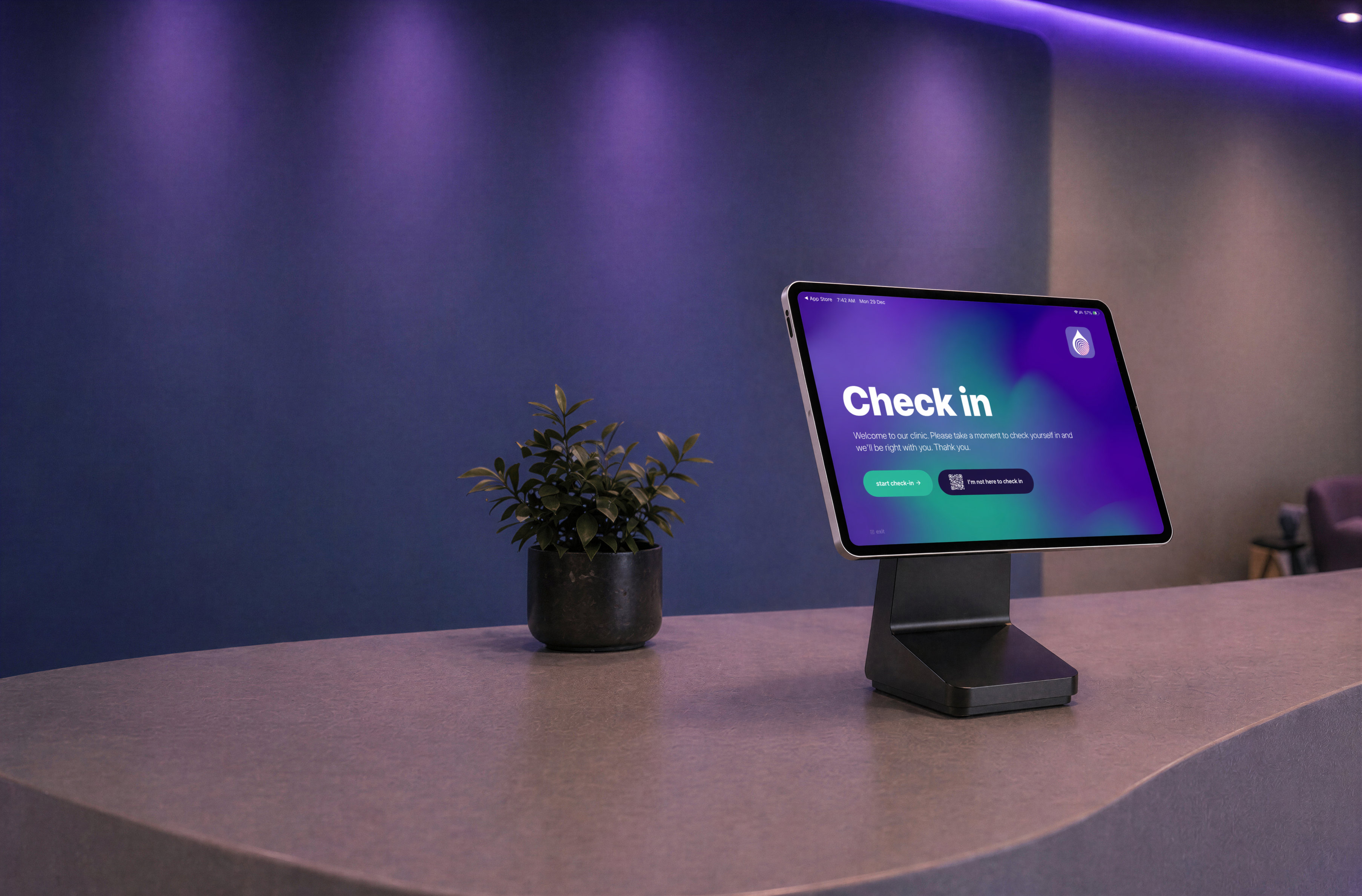
A dedicated iPad sits at the front desk as the kiosk. Patients check themselves in — existing patients by tapping their details, new patients by completing their information on the spot. If a patient arrives without having completed their intake form, the iPad becomes a fallback: they sit down, fill it in, and the data goes straight into their Cliniko file. No scanning. No re-keying. No mixing up email addresses from handwriting.
“Having it just go straight in, so not having to type it out and mixing up letters, getting it right has been really good.”
— Sarah Colston, Owner & Physiotherapist, Newcastle Aquatic Physiotherapy
The kiosk doesn’t replace the front desk at Newcastle Aquatic, it supplements it. The receptionist is still there, still managing the workflow that comes with a pool and nine practitioners. But the queue pressure during peak hours is handled by the iPad, not by a person. Patients who know the system check themselves in. Patients who need help get it from the receptionist without three other people waiting behind them.
Newcastle Aquatic is the first account in the programme where clinicians use Finger-Ink during patient sessions for clinical outcome measures. The OMPQ, Berg Balance, and patient-specific functional scales (assessments that are often mandated for workers’ compensation and NDIS reporting) are administered on iPads using Finger-Ink forms. Results sync directly to the patient’s Cliniko file.
This is a qualitatively different use case from check-in or pre-appointment forms. The product is being used as a clinical tool, not an administrative one. A practitioner preparing for a workers’ comp review can set up the outcome measure forms on the iPad before the patient walks in. Or they can hand the iPad to the patient during the session itself and use the form as their note-taking device.
The data goes straight into Cliniko. No paper transcription. No risk of copying errors into a report that may be read by an insurer or a case manager. For a clinic where outcome measures are not optional but mandated, that reliability matters.
Sarah is candid about the learning curve. Setting up Finger-Ink for the first time, in her words, “took a little time.” Linking forms to Cliniko, saving themes, configuring iPads. All the kind of setup work that makes sense once you understand the language, but can feel alienating when you don’t.
She persisted. And what changed the experience wasn’t just her own determination, it was the support behind the product. The Finger-Ink team now sets up forms for her. Template sharing means she can use forms built for other clinics. Recently, when she needed sleep score forms she didn’t have, they were already available as shared templates.
“They’re really responsive and really willing to, if they can’t do it, either work on an alternative solution … or go, oh, let’s have a look at it.”
— Sarah Colston, Owner & Physiotherapist, Newcastle Aquatic Physiotherapy
Sarah contrasts this directly with her experience of other tech vendors. Google’s customer service, she says, was “appalling.” Feedback disappeared into a void. With Finger-Ink, if something isn’t possible, Brendan says so honestly. If there’s a workaround, he builds it. If it’s a genuine limitation, he’s upfront about it.
For a clinician-owner who describes herself as someone who gets overwhelmed when faced with tech jargon, that kind of support is not a nice-to-have. It’s the reason she’s still a customer.
A year in, both Finger-Ink products are in daily use across the clinic. The kiosk handles patient check-in during the busiest hours of the day. Digital forms have replaced the paper-and-email workflow that Sarah inherited. The custom website flow routes patients through the right pathway before they can book. Clinicians are using iPads for in-session outcome measures that sync directly to patient files in Cliniko.
The practice continues to add new forms and workflows. Template sharing, a feature that didn’t exist when Sarah started, has made that faster. The product is evolving, and so is the clinic’s use of it. Sarah’s verdict is characteristically practical.
“I’ve definitely been really happy.”
— Sarah Colston, Owner & Physiotherapist, Newcastle Aquatic Physiotherapy
From a clinic that was too complex for simple solutions, Newcastle Aquatic Physiotherapy is now running on one integrated system, from the website to the front desk to the treatment room.
Sarah is already exploring new Finger-Ink forms for sleep scores and additional outcome measures. Template sharing means the library of available forms continues to grow. The clinic’s next priority is expanding the website booking flow to cover more patient pathways and integrating additional clinical assessment tools into the iPad workflow.
Finger-Ink handles the routing, the forms, and the check-in, all syncing to Cliniko. Sets up in an afternoon, no code required. Start a free trial.

Patient check-in kiosk and intake forms for allied health clinics.
