How Orthotics NZ’s practice manager inherited Finger-Ink, fixed the duplicate records problem herself, and freed up to 12 hours of admin time every week.
Orthotics NZ is not your typical Finger-Ink customer. Based in New Plymouth, the specialist practice provides orthotic bracing, compression garments, and footwear for patients referred by GPs, physiotherapists, and orthopaedic surgeons across the Taranaki region. When Jody Reutemann joined as practice manager, Finger-Ink was already in place. Her verdict, three years later: a 10 out of 10.
Before Finger-Ink, every new patient at Orthotics NZ meant paperwork, and not the kind that filed itself. Registration and consent forms were paper-based. Patients filled them out on-site. The admin team then scanned each form, renamed the file, and manually uploaded it into Cliniko. For a practice seeing 50 to 70 patients a week in their private clinic alone, that manual process added up fast.
Jody estimates the old workflow consumed at least five minutes per patient, sometimes closer to ten. Print the form. Hand it out. Collect it. Walk to the scanner. Scan. Rename the file so it’s findable. Upload to Cliniko. Repeat, dozens of times a week. It was reliable in the sense that it worked, but it was the kind of reliability that costs hours of admin time that could be spent on something more useful.
The practice also had a problem it didn’t fully see until later: duplicate patient records. Without forms linked to Cliniko patient IDs, a patient who changed their name or email address (married, moved, switched providers) would generate an entirely separate record. Patients would arrive saying “I’ve already filled this out” while reception couldn’t find their details. Records had to be tracked down and manually merged.
Finger-Ink was already at Orthotics NZ when Jody arrived. A colleague had found it on the Cliniko integrations directory, the same discovery channel that surfaces Finger-Ink for most of its customers. The system was set up and running, handling registration and consent forms for every patient.
Jody’s first impression was straightforward: it made sense.
“The system itself is really intuitive to use. Everything sort of linking together, I find is really good.”
— Jody Reutemann, Practice Manager, Orthotics NZ
She didn’t need training. She didn’t need a walkthrough. She came into an operational system and understood how it worked. For a product that needs to survive staff transitions, that’s a proof point worth noting. Finger-Ink didn’t just work for the person who set it up. It worked for the person who walked in after them.
But Jody didn’t stop at understanding it. She improved it.
The duplicate patient records weren’t a Finger-Ink defect, they were a configuration gap. Forms were being sent without being linked to Cliniko patient IDs. When a patient’s details changed between visits, the system treated them as a new person. The result was duplicate records, confused patients, and admin time spent merging files.
Jody identified the problem and fixed it herself. She configured the forms to link to Cliniko patient IDs, ensuring that every submission attached to the correct patient record regardless of name or email changes. The duplicate record problem, in her words, “improved quite a lot.”
She didn’t stop there. She set up medical alert triggers from form fields. If a patient flagged an allergy or a medical condition on their registration form, Cliniko would automatically surface a medical alert for the clinician. It’s the kind of configuration that turns a forms tool into an operational safety net, and Jody did it without asking anyone for help.
“The more automation I can get, the better.”
— Jody Reutemann, Practice Manager, Orthotics NZ
The workflow at Orthotics NZ is clean and repeatable. When a patient books an appointment, a registration and consent form link is included in the confirmation email. Most patients complete it at home before their visit, no early arrival required, no time spent in the waiting room with a clipboard.
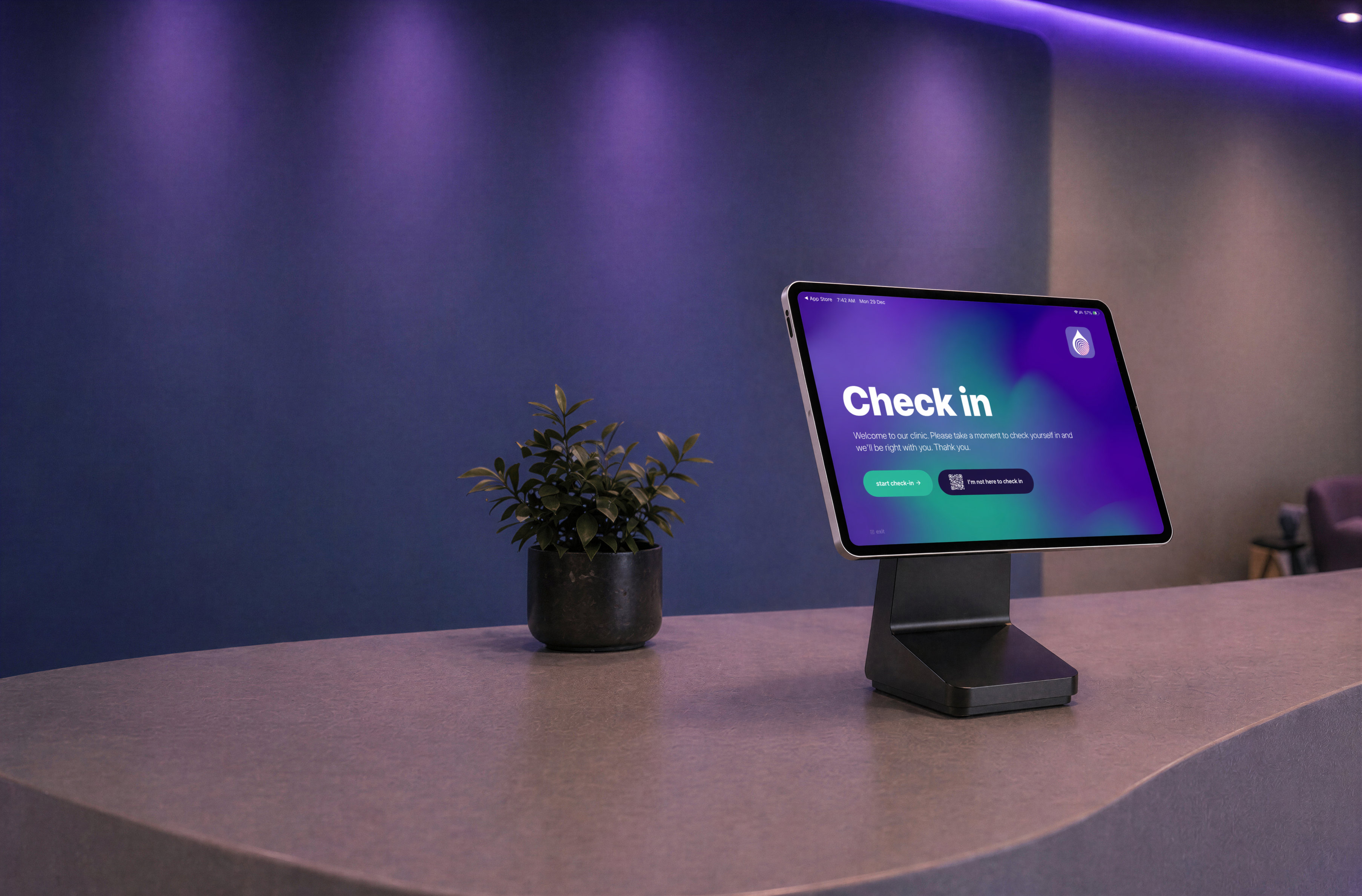
When a patient arrives, reception confirms the booking and checks whether the form has been completed. If it has, the data is already in Cliniko. If it hasn’t, the patient completes the form on an iPad in the clinic. In rare cases, typically older patients with limited digital literacy, a paper form is still available as a fallback.
The system rarely needs attention. Jody updates the forms when policies change, but otherwise, the setup runs without intervention.
“It’s just a set and forget.”
— Jody Reutemann, Practice Manager, Orthotics NZ
That phrase “set and forget” appears again and again across Finger-Ink’s customer base. But it carries particular weight coming from a practice manager who inherited a system, reconfigured it to solve real operational problems, and then found she could leave it alone. The product earns the description not because it’s simple, but because the complexity is handled once and doesn’t come back.
Orthotics NZ retains a full reception function. Patients check in with a person, not a kiosk. In a programme where self-service check-in is a headline feature, this might seem like a missed opportunity. It isn’t.
The clinic’s consent form is long, several pages of detailed registration and medical history required for specialist orthotic care. Patients frequently need assistance completing it. Older patients, patients with limited English, and patients who are anxious about a surgical referral, all need someone at the desk, not a screen.
Jody is pragmatic about it. If check-in were as simple as a patient tapping to confirm arrival, self-service would work. But for a practice where the form is the first clinical interaction, where the data captured determines what the clinician knows walking into the appointment, the human touch at reception is operationally necessary, not a holdover from habit.
The iPad isn’t a kiosk at Orthotics NZ. It’s a form-completion tool. And the distinction matters, because it shows that Finger-Ink adapts to how a practice actually operates rather than forcing a single model of patient flow.
Most case studies feature the clinic owner or the lead clinician. Jody is neither. She’s the practice manager, the person who lives inside the admin system every day, who notices when a workflow is three clicks too many, who cares about whether a form generates a duplicate record because she’s the one who has to merge it.
Her description of Finger-Ink is telling. She doesn’t talk about patient experience or brand impression. She talks about integration, automation, and efficiency. She describes it exactly the way a practice manager thinks about it:
“It’s an integration tool to assist alongside admin to help reduce admin workload, or create more efficiencies in terms of the workload.”
— Jody Reutemann, Practice Manager, Orthotics NZ
That perspective is valuable precisely because it’s operational, not aspirational. Jody is not selling a vision of digital transformation. She’s describing a tool that saves her team time, reduces errors, and runs without requiring ongoing effort. For practice managers reading this and recognising their own daily frustrations, that’s the endorsement that matters.
Orthotics NZ is not physiotherapy, chiropractic, osteopathy, or podiatry. It’s a specialist bracing practice, working on referral from GPs and surgeons, providing orthotic devices, compression garments, and footwear. Most Finger-Ink customers fall within the traditional allied health disciplines. Orthotics NZ proves the product’s value extends further.
The use case is narrower with registration and consent forms, not clinical outcome measures or complex multi-pathway routing. But the operational value is the same: forms that sync to Cliniko, admin time reclaimed, and a system that works without constant attention. Anywhere there’s a registration and consent workflow feeding into Cliniko, Finger-Ink delivers.
Jody is already thinking about what comes after. Orthotics NZ is investigating ACC (Accident Compensation Corporation) integration possibilities, which would be a significant pain point for New Zealand practices where most patients arrive via referral with existing ACC claim numbers. The current invoicing process through Cliniko is manual and time-consuming. It’s outside Finger-Ink’s current scope, but it signals the kind of operational thinking that drives how Jody approaches every system in the practice.
From a specialist bracing practice that inherited a forms tool and might never have thought twice about it, Orthotics NZ has become one of Finger-Ink’s most operationally engaged customers, led by a practice manager who found a system that worked, made it work harder, and rated it 10 out of 10.
Finger-Ink handles everything from registration forms to consent capture. Sets up in an afternoon, no code required. Start a free trial.

Patient check-in kiosk and intake forms for allied health clinics.
