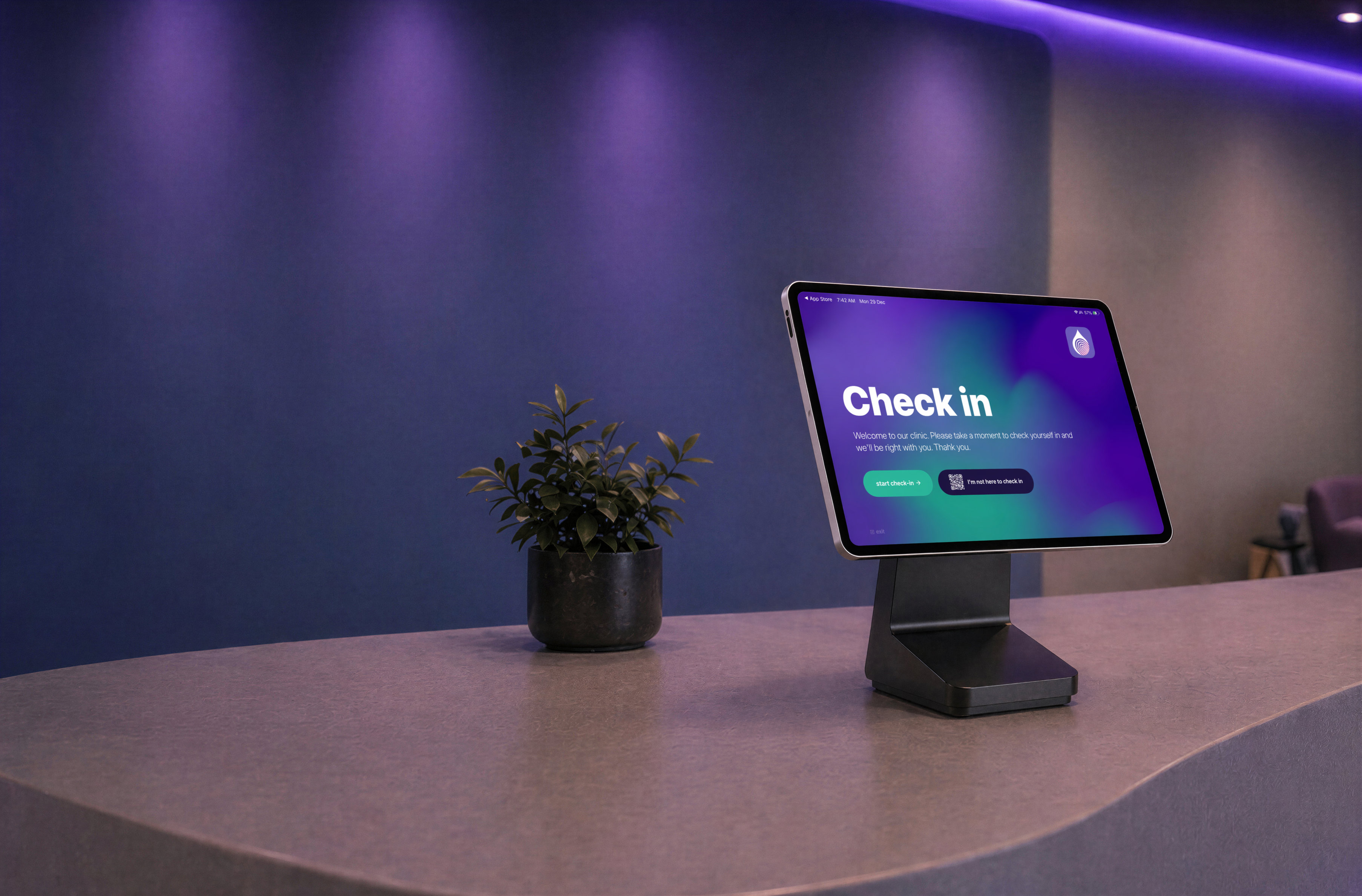
Ed Roper has run Precision Chiropractic on the same Finger-Ink configuration for eight years. Around 300 patient visits a week. Around 600 new patient forms a year. Four iPads. No kiosk, by choice.
Precision Chiropractic is a three-chiropractor clinic in Tauranga, New Zealand, with four part-time front desk staff and an office manager. About 300 patient visits a week move through the clinic. Around 600 of those, every year, are new patients walking through the door for the first time.
The chiropractic model is high-throughput by design. The average New Zealand chiropractor sees 80 patients a week; Ed sits comfortably at 120 to 130. Appointments are short. Care is regular. A lot of what the clinic does is preventative — the wellness end of chiropractic, not just injury work — and that means a steady weekly rhythm of returning patients, with new ones layered on top.
At that volume, anything that is even slightly unreliable on the admin side surfaces fast.
Before Finger-Ink, every new patient meant the same chain of admin. The patient filled out a paper form, two pages, fairly exhaustive. Ed scribbled his notes on the bottom. The front desk team scanned it locally to the network, renamed the file, and dragged it into Cliniko. Same job for ACC forms. Same job for informed consent. New patient after new patient.
Ed had come from a practice with twenty years of accumulated paper files. Three thick folders per patient, going back decades. He didn't want to repeat that pattern at Precision. He wanted to go paperless from the start.
“It saved us a heap of work, just administratively. Just not dragging and dropping stuff and scanning. It freed up our team to actually be patient-facing and take care of the people in front of them or the phone calls in front of them, rather than worrying about an administrative task in the background.”
- Ed Roper, Owner & Chiropractor, Precision Chiropractic
Ed cannot remember exactly how he came across Finger-Ink. It was 2018. It might have been a Cliniko Facebook group, it might have been a Google search, it might have been something he stumbled on while looking for a way to handle digital notes. “It obviously wasn't that memorable,” he says of the alternatives.
What he does remember clearly is that Brendan (the Finger-Ink founder) was local. Tauranga to Tauranga. Brendan came into the office in person, sat down with Ed, and walked him through the product. That conversation is the one that closed it. The product was simple, it integrated with Cliniko, and the founder was someone Ed could meet face-to-face.
Four iPads in the clinic, each running the Finger-Ink app. A new patient form built once, refined a little since, otherwise unchanged. The same form covers most of what the clinic needs for new intake, branded with the clinic's logo, syncing directly into the patient's Cliniko record.
Beyond new patient intake, two more workflows live on Finger-Ink. A history update form for returning patients who haven't been in for 12 to 24 months: have you been to hospital, have you had any surgeries, what's changed. And an ACC re-evaluation form with five questions tracking how a patient's symptoms have moved since the last visit. Both run on the same iPads, both sync the same way, both replaced a paper-and-scan workflow that used to fall on the front desk.
“It just does what we want it to do without causing the headaches. And even our low-tech people can pick it up and manage it.”
- Ed Roper, on eight years of running Finger-Ink
Precision Chiropractic has every reason to use a check-in kiosk. High patient volume, four iPads already in the building, an office that runs on tight rhythm. They don't use one. Not because they can't, but because Ed doesn't want to.
“I call it door slam time. So the idea is when somebody closes their door from their car, comes into our office for treatment, and then goes back to the car and closes the door again — that's the journey that we can influence.”
- Ed Roper, on why Precision Chiropractic keeps a full front desk
The front desk team is part of the clinical outcome, in his view. The conversation a patient has with reception, how they're greeted, what's noticed about their day, the warmth or attention or quiet check-in on someone who's had a rough week, that is all part of the care. He isn't trying to remove the human from that interaction. He is trying to remove the admin from it, so the human can do the work that matters. Forms cover the admin. The front desk covers the welcome. That's the deliberate split.
Ed has been a Finger-Ink customer since 2018. The configuration he runs today is, in essence, the configuration he set up in the early days. Around 600 new patient forms a year, every year, processed across four iPads. No system change, no rewriting, no search for a replacement. The product has, by his own description, become invisible: it does what he wants it to do, and it doesn't generate problems that need fixing.
Ed is not retained by inertia. He is, by background, the systems person at the practice. The brains of the operation, in his words, and he runs his subscriptions seriously. He is comfortable cancelling tools that aren't earning their place. Finger-Ink is an earner.
Recently Ed sat with a friend at a physiotherapy practice running on a different patient management system. He filled out a form there. It came back to mind in our conversation. The form, he said, had no prettiness to it. Just a standard, unbranded thing handed across the front desk.
He hasn't done much to customise his Finger-Ink forms beyond putting his logo on them, he said. He hasn't changed colours or themed anything elaborately. He has, in his words, just “banged the logo on it and sorted it out.” Even that, compared to what he had seen elsewhere, was — and these are his words — a much more refined experience.
That comment matters because Ed does not lead with aesthetics. He is a ‘systems and operations’ person. When a buyer with that disposition comments, unprompted, on the design difference, the difference is real.
There is a Saturday clinic on the team's whiteboard, possibly running without front desk staff. If that comes off, Ed would consider the kiosk for that single use case - the one scenario where he would deviate from the door-slam rule. For the rest of the week, the front desk stays.
In the meantime, Ed continues to recommend Finger-Ink to other chiropractors making the move to digital, particularly those new to Cliniko or planning the transition. He puts a number of them onto Finger-Ink each year. It is, in his framing, the simplest answer to the paperwork problem he can give a colleague.
See what Finger-Ink takes off your team's plate. Start a free Finger-Ink trial. Syncs with Cliniko in under an hour. No credit card required.

Patient check-in kiosk and intake forms for allied health clinics.